
About narration
Uses speech voices provided by your browser or device. Availability, quality and online processing depend on that service.
Why savings may not reach customers
A falling solar-panel price does not automatically lower a factory's electricity bill. Between the equipment and the customer sit a connection, a financing structure, a utility, a tariff and a promise to deliver when production needs power. Costs and failures at any of these stages can absorb the savings before they reach the business.
The World Bank's Independent Evaluation Group found that financially weak utilities absorbed savings from supply expansion and cost reductions to cover operating losses, limiting the affordability gains reaching customers. Its assessment covers the Bank Group's support for electricity access in sub-Saharan Africa during 2015–25. [1]
This finding suggests that investors should pay as much attention to delivery costs and reliability as to generation costs. Customers may still pay high prices if financing, utility losses or unreliable supply consume the savings on equipment.
Equipment costs are only part of the bill
Africa accounts for a small share of new renewable capacity worldwide. IRENA records 11.3 GW of renewable capacity added in Africa in 2025: only 1.6% of the global addition. These are installed-capacity figures, not electricity generated or customers reliably served. [2]
Financing changes the economics of identical equipment. IRENA's 2024 generation-cost analysis used cost-of-capital assumptions of 3.8% for Europe and 12% for Africa. These are modelling assumptions, not quotations available to every project. They nevertheless show why comparing equipment prices without comparing financing is misleading. [3]
For assets with large upfront costs, lenders charge for revenue uncertainty over the life of the loan. Currency exposure, delayed connections and an unreliable buyer can overwhelm a modest discount on panels. Procurement teams need to compare those costs with the saving on equipment before choosing a bid.
Check the connection timetable
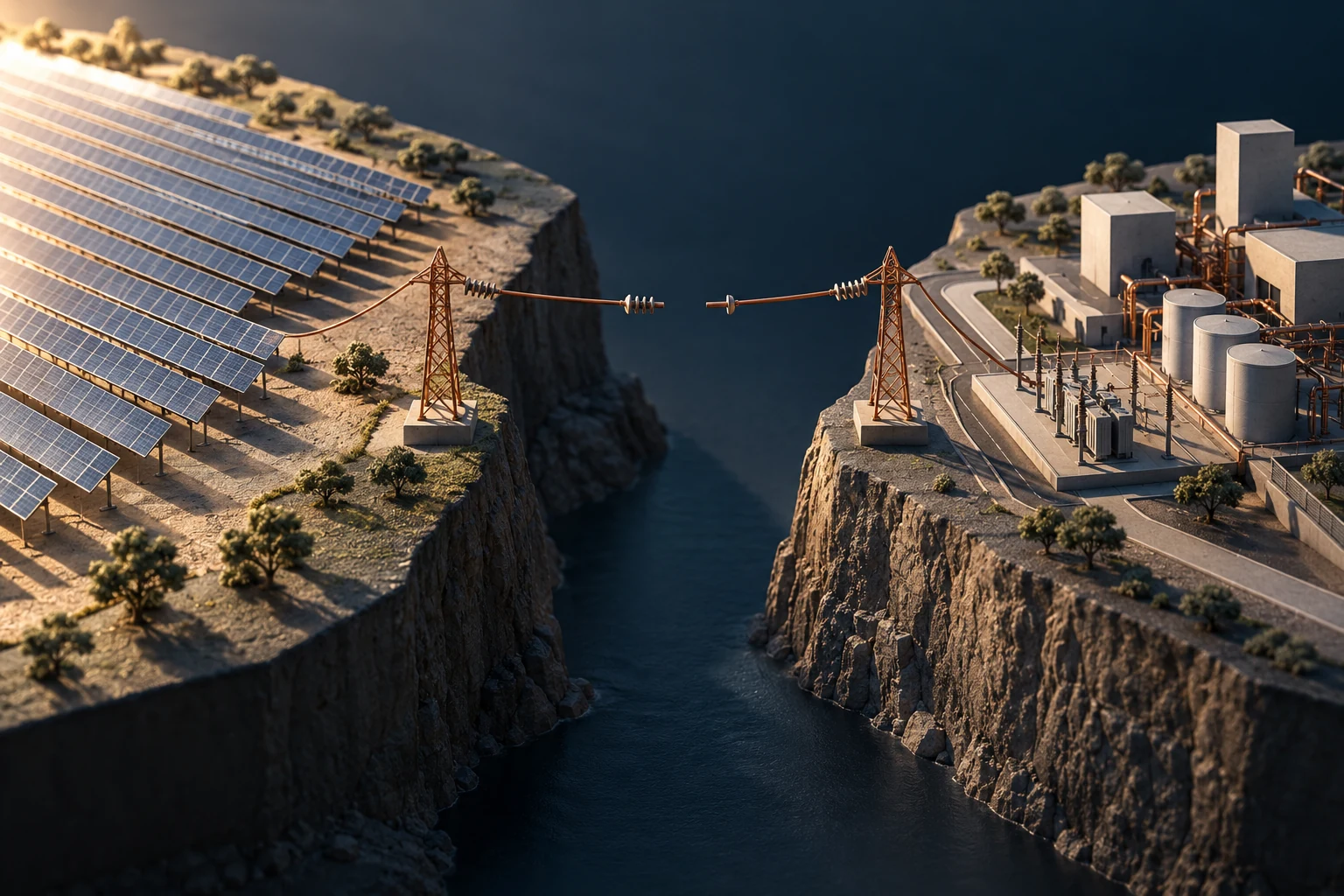
In South Africa, a generation project can be ready before the network can connect it. Eskom's 2025 integrated report describes a transmission plan requiring approximately 14,500 km of new high-voltage lines by 2034. A development plan is a statement of required infrastructure; it is not evidence that a particular connection will be available on a promised date. [4]
Buyers need to check what the connection offer depends on. That includes land access, approvals, equipment, funding, commissioning and responsibility for delay. A power purchase agreement can promise attractive energy while leaving the buyer exposed to a network milestone that neither commercial counterparty controls.
An investment assessment should calculate the effects of a delayed connection and restricted output alongside its expected returns. It should identify who carries financing during the delay, what electricity replaces the missing supply, and when termination or renegotiation becomes possible. These are commercial questions to settle with the relevant technical and legal advisers before commitments become expensive to unwind.
Account for the shared network
A mine or factory buying its own solar and storage can improve its operating resilience. That decision does not, by itself, fund the network needed by its suppliers, workforce or surrounding communities. Where a utility relies on large customers to recover fixed costs, poorly designed charges can leave a shrinking customer base carrying more of the system. Whether this happens depends on how the utility recovers its costs.
Transparent network charges, payment for services actually used and competitively procured capacity can help fund shared infrastructure. Businesses should assess how their project affects those finances. A project can be profitable in isolation yet dependent on roads, water and electricity systems whose finances it has not considered.
In the DRC, planners also need to distinguish between reliable supply for an industrial site and first connections for nearby communities. These customers need different services and have different capacities to pay. Combining them in one optimistic revenue forecast conceals the subsidy or public investment required. Separating the accounts makes that support visible and negotiable.
Finance the activities that use electricity
The IEA's 2025 electricity-access study estimates that reducing financing costs to advanced-economy levels could cut project costs by up to 25% and make basic services affordable for 40 million additional people. That is a modelled scenario, not an achieved outcome. [5]
Concessional finance can close part of the gap, but a new meter does not create a paying customer with sufficient income. Refrigeration, irrigation, processing and workshops need equipment, working capital and access to markets. An electricity project risks overestimating demand if it assumes these activities will start without the necessary finance.
Mission 300 explicitly combines network expansion, distributed solutions, utility reform and private investment. In June 2026, the World Bank and African Development Bank reported more than 50 million people connected under the initiative. Connection counts are useful progress indicators; businesses and public funders should also ask about reliability, affordability and sustained use. [6]
Investment can proceed while reforms continue
Weak institutions need not prevent all renewable investment. Distributed generation can supply useful power while larger reforms proceed. Storage, demand management and flexible production can reduce exposure to some network constraints. Waiting also has a cost: fuel purchases, lost output and deferred expansion.
Buyers should specify the service they need. A daytime energy contract, a firm overnight supply and backup for a critical process are different products. Their bids should be compared against the same operating requirement, including residual supply, maintenance, replacement and curtailment. The price per kilowatt-hour leaves out these differences.
Development finance should likewise be judged by the constraint it removes. A guarantee that solves a specific payment risk may unlock a viable project. A broad guarantee that shelters an unreformed buyer can shift losses onto the public balance sheet without improving delivery. The guarantee should state who bears each risk and what the buyer must deliver.
Test the delivery risks before investing
An investment committee should be able to trace one unit of contracted electricity from production to productive use, and one unit of customer revenue back through the payment chain. The exercise exposes who owns the connection date, who pays when generation is constrained, who bears currency movements and who funds maintenance after commissioning.
Then calculate what happens if a critical dependency fails. A project needs a plan for unpaid invoices and unavailable feeders, even when solar conditions and tariffs are favourable. Assign someone to manage each risk and budget for a response. A general contingency allowance may not cover the delay or interruption involved.
Generation investment and improvements in utility management can proceed together. The investment decision should account for both, with explicit commitments on connections, payment and maintenance. That gives customers a better chance of receiving the cost savings promised by cheaper technology.
A question for your team
Which unresolved delivery dependency could erase the savings in our next energy investment?
Sources & notes
Sources checked on 29 October 2026. This article presents our analysis of the cited research and its implications for businesses. Numbered references link to the original sources.
- World Bank Independent Evaluation Group. Electricity access in Sub-Saharan Africa, FY2015–2522 October 2026
- IRENA. Renewable capacity statistics 2026March 2026
- IRENA. Renewable Power Generation Costs in 202422 July 2025
- Eskom. Integrated report 2025, transmission development, p. 1052025
- IEA. Financing Electricity Access in Africa, executive summary2025
- World Bank / AfDB. Mission 300 connection milestone16 June 2026